Featured Projects

VR Egress Training


Immersive vs. Traditional Training​ – a comparison of training modalities​

Industry 4.0/5.0 grant. 2023

PIs: Tamara Lorenz, Ming Tang

  • Dr. Tamara Lorenz. Associate Professor. Embodied Interactive Systems Lab, Industry 4.0 & 5.0 Institute (I45I), Center for Cognition, Action, and Perception (CAP)
  • Ming Tang. Professor. Extended Reality Lab, Industry 4.0 & 5.0 Institute (I45I), Institute for Research in Sensing (IRiS)

Consortium Research Project: evaluate the effectiveness of an immersive training protocol against different traditional training modalities. 

Grant. $40,000. By UC Industry 4.0/5.0 Institute 01.2023-01.2024

Open Questions

  • Is immersive training equally as effective or better than traditional training? 
  • Is immersive training beneficial for specific types of training (skill, behavior), while other modalities are better for other types (e.g. knowledge acquisition)?
  • Does the benefit of immersive VR training warrant the initial investment in equipment and subsequent investment in project building, running, and sustenance?

Proposal

  • Evaluation of the effectiveness of an immersive training protocol against different traditional training modalities. 
  • Evaluation of modality-dependent benefits for different learning goals. 
  • Derivation of assessment metrics for VR training against other training modalities. 

Training scenario: DAAP Fire Evacuation

traditional training with slides and maps.

VR training with an immersive and interactive experience.


Thanks to the Institute’s Industrial Advisory Board (IAB) and industry patrons, including Siemens, Kinetic Vision, John Deere, Stress Engineering Services, Innovative Numberics, and Ethicon. 

Next Phase experiments

Multi-player test


Links

Ming Tang, Mikhail Nikolaenko, Evv Boerwinkle, Samuel Obafisoye, Aayush Kumar, Mohsen Rezayat, Sven Lehmann, and Tamara Lorenz. (2024). Evaluation of the Effectiveness of Traditional Training vs. Immersive Training. In: De Paolis, L.T., Arpaia, P., Sacco, M. (eds) Extended Reality. XR Salento 2024. Lecture Notes in Computer Science, vol 15030. Springer, Cham. https://doi.org/10.1007/978-3-031-71713-0_7

 2017 Virtual DAAP Fire Evacuation project.


At UC News

New UC institute looks ahead to ‘Industry 5.0’. UC will harness collective talent across campus to help companies solve new challenges. by Michael Miller.  December 8, 2022


o4a AAA Partnership Award

2022 Outstanding AAA Partnership Award of the Year


On behalf of COA and Live Well, Ken Wilson (COA) and Ming Tang (UC)  received the AAA Award at the o4a conference. 10.20.2022. It is my great honor to represent Live Well as the co-recipient with the Council on Aging to receive the 2022 Ohio Association of Area Agencies on Aging Annual Partnership Award. Thanks to Suzanne Burke, Ken Wilson, Jai’La Nored, Anna Goubeaux, and many others from COA. Thanks to the Live Well EVRTalk development team (Faculty: Ming Tang, Matt Anthony; advisor: Craig Vogel, Linda Dunseath; Students and Live Well fellows: Tosha Bapat, Karly Camerer, Jay Heyne, Harper Lamb, Jordan Owens, Ruby Qji, Alejandro Robledo, Matthew Spoleti, Lauren Southwood, Ryan Tinney, Keeton Yost, Dongrui Zhu.)

Link: LWC Twitter

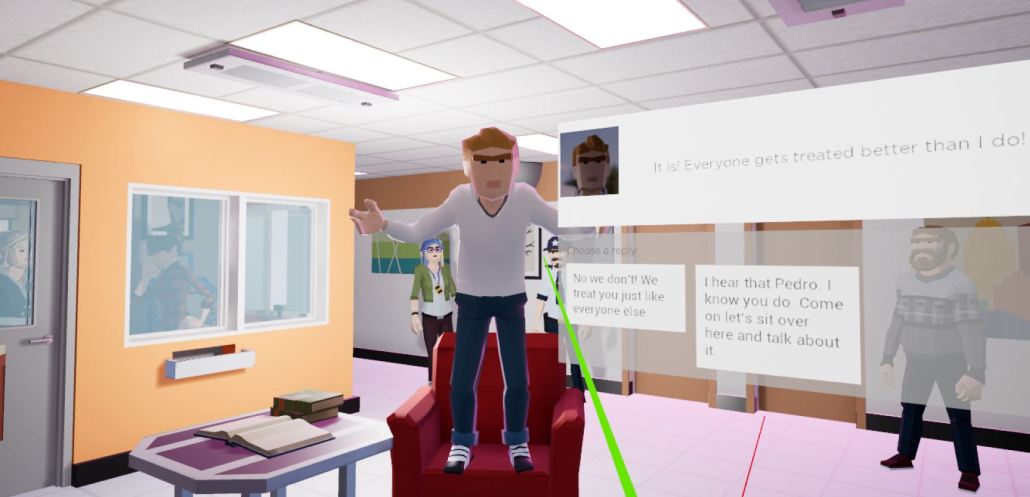
Therapeutic Crisis Intervention Simulation. P1,P2

VR-based Employee Safety Training. Therapeutic Crisis Intervention Simulation 

Grant:

  1. Virtual Reality for Employee Safety Training. Phase I. Sponsored research by the Cincinnati Children’s Hospital Medical Center. PI. Ming Tang. $16,631. Period: 6.2022- 09.2022.
  2. Virtual Reality for Employee Safety Training.Therapeutic Crisis Intervention Simulation-Phase II.  Sponsored research by the Cincinnati Children’s Hospital Medical Center. PI. Tang. $22,365. Period: 2.2023- 12.2023.

Under the leadership of Ming Tang, the XR-Lab is collaborating with the Cincinnati Children’s Hospital Medical Center (CCHMC) to develop a VR-based simulation to enhance employee safety training. This initiative involves creating a virtual hospital environment with interactive characters to facilitate research on diverse scenarios encountered during therapeutic crisis interventions. A vital feature of this simulation is the VR dialogue between a staff member and a teenage patient exhibiting aggressive behavior and mental illness. The primary objective is to equip staff members with the necessary skills to de-escalate tense situations effectively and adhere to appropriate protocols, thereby ensuring a safer and more controlled environment for staff and patients.

Team:

  • Ming Tang, Nancy Daraiseh, Maurizio Macaluso, Krista Keehn, Harley Davis, Aaron Vaughn, Katheryn Haller,  Joseph Staneck, Emily Oehler
  • Employee Safety Learning Lab, CCHMC
  • Extended Reality (XR) Lab, UC

Field of research: Virtual Reality, Safety Training, Therapeutic Crisis Intervention, Mental Health,  Human Behavior Simulation

screenshots from  Mobile VR Quest 2 headset.


Tilted Deck. Design Build in China

Ming Tang, Yingdong Hu advised a group of BJTU students to participate in the “Xinzhaiping” Rural Design-Build Competition in China in 2021.

Project name: Titled Deck. 

BJTU Students: Bingxu Gao, Zhu Chen, Xiangyu Zhou, Haolong Guo.

Advisors: Yingdong Hu (BJTU), Ming Tang (UC)

Location: Hunan Province, China.

More info on the competition “2021乡见新寨坪·乡村建造大赛”

Award:

The build project won second place in the Rural Design Build competition 2021.

The build project also won the excellent award of the 19th 2021 Asian Design Awad.


Exhibition: The Architecture Machine

Ming Tang, Dihua Yang’s work was featured at the exhibition “The architecture machine“. architekturmuseum der TUM. München. Germany. October 14th, 2020-June,6. 2021.


The Architecture MachineOctober 14, 2020 – June 6, 2021 | Slow Opening: October 13, 2020, 2 p.m.
The Role of Computers in Architecture

Read more