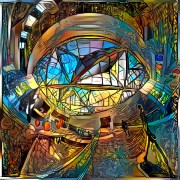
A.I controlled computer vision using a convolutional neural network (CNN) by Google AutoML, and Deep Dream. Machine Learning, object detection and image classification. By Ming Tang’s students in ARCH3014, Summer. 2020, ARCH4001, ARCH7014, SAID, DAAP, UC. Fall 2018.
Grant: “Project-Based Collaborative Coursework for Developing Connected Transportation Network and Accessible Multimodal Hub in Uptown”. UC Forward grant. Co-PI: Heng Wei, Na Chen, Xinhao Wang, Jiaqi Ma, Ming Tang. $5,000. Total $27,500.
ARCH4001. Fall. 2018. SAID, DAAP, UC.
Faculty: Ming Tang, RA, LEED AP, Associate Professor. UC
Using Cincinnati Uptown and proposed Smart Corridor area as the focus area, the studio presents a study investigating the urban mobility with an emphasis on the simulated human behavior cues and movement information as input parameters. The research is defined as a hybrid method which seeks logical architecture/urban forms and analyzes its’ performance. As one of the seven-courses-clusters supported by UC Forward, the studio project extends urban mobility study by exploring, collecting, analyzing, and visualizing geospatial information and physically representing the information through various computational technologies.
The studio investigation is intended to realize the potential of quantifying demographic, social, and behavior data into a parametric equation. In the experiments, the integration of non-geometrical parameters within the form seeking and performance evaluation process resulted in a series of a conceptual model to represent the movement and access. The projects will be developed by optimizing transportation network, analyzing way-finding and human behavior. Ultimately, the studio looks to build upon the strengths pre-defined in the evaluation method and capture the benefits of Geographic Information System (GIS), virtual reality (VR), eye-tracking, and wayfinding simulation by seamlessly integrating vital geospatial components in the equation and altering the way people explore the possible design solutions in order to generate the ideal urban and building forms.
Students: Nolan Dalman, Sam DeZarn, Nicole Powers, Jake Miller, Hang Phan, Josh Funderburk, Rugui Xie, Nick Mann, Azrien Isaac, Shiyuan li, Spencer Kuehl, Randall Morgan, Greg Ginley, Umme Habiba
UC Forward Collaborative on Smart Transportation Forum at Niehoff studio
Augmented Reality for Digital Fabrication. Projects from SAID, DAAP, UC. Fall 2018.
Hololens. Fologram, Grasshopper.
Faculty: Ming Tang, RA, Associate Prof. University of Cincinnati
Students: Alexandra Cole, Morgan Heald, Andrew Pederson,Lauren Venesy,Daniel Anderi, Collin Cooper, Nicholas Dorsey, ,John Garrison, Gabriel Juriga, Isaac Keller, Tyler Kennedy, Nikki Klein, Brandon Kroger, Kelsey Kryspin, Laura Lenarduzzi, Shelby Leshnak, Lauren Meister,De’Sean Morris, Robert Peebles, Yiying Qiu, Jordan Sauer, Jens Slagter, Chad Summe, David Torres, Samuel Williamson, Dongrui Zhu, Todd Funkhouser.
Project team lead: Jordan Sauer, Yiying Qiu, Robert Peebles,David Torres.
Videos of working in progress
https://i1.wp.com/ming3d.com/new/wp-content/uploads/2019/01/AR_cut.jpg?fit=2292%2C146114612292Ming Tanghttp://ming3d.com/new/wp-content/uploads/2022/01/TY_logo-300x300-new.pngMing Tang2019-01-03 00:07:002022-09-28 01:04:21AR based Digi_Fab
This paper describes an innovative integration of eye-tracking (ET) with virtual reality (VR), and details the application of these combined technologies for the adaptive reuse redesign of the Wudaokou rail station in Beijing. The objective of the research is to develop a hybrid approach, combining ET and VR technologies, as part of an experimental study of how to improve wayfinding and pedestrian movement in crowded environments such as those found in urban subway stations during peak hours. Using ET analysis, design features such as edges, and color contrast are used to evaluate several proposed rail station redesigns. Through VR and screen-based ET, visual attention and related spatial responses are tracked and analyzed for the selected redesign elements. This paper assesses the potential benefits of using ET and VR to assist identification of station design elements that will improve wayfinding and pedestrian movement, and describes how the combination of VR and ET can influence the design process. The research concludes that the combination of VR and ET offers unique advantages for modeling how the design of rail transit hub interiors can influence the visual attention and movement behavior of those using the redesigned station. This is especially true for crowded conditions in complex interior spaces. The use of integrated ET and VR technology is shown to inform innovative design approaches for facilitating improved wayfinding and pedestrian movement within redesigned rail stations.
Prof. Ming Tang was invited as a panelist and presented his Virtual Reality and Augmented Reality research projects at the Navigating the New Longevity Symposium organized by the Village Chicago on November 7. The symposium topic is “How Will Virtual Reality Change Your Future?”
The Village Chicago organized a lively discussion of how immersion technology is changing the way we live, learn and care, a conversation exploring how immersion technology is transforming our well-being at all ages and stages of life – and be inspired to suggest new ways it can be put to use. Panelists include Neelum T. Aggarwal, M.D.; Carrie Shaw, CEO, Embodied Labs; Ming Tang, RA University of Cincinnati; and Emily Phelps, medical student of Rush University Medical Center.
Carrie Shaw, CEO, Embodied Labs presented at the symposium.
https://i0.wp.com/ming3d.com/new/wp-content/uploads/2018/11/chicago_villiage.jpg?fit=549%2C679679549Ming Tanghttp://ming3d.com/new/wp-content/uploads/2022/01/TY_logo-300x300-new.pngMing Tang2018-11-14 03:33:252022-09-28 01:04:44Navigating the New Longevity Symposium