Book available: MetroLAB

MetroLAB is a public-interest design/build program at the University of Cincinnati School of Architecture and Interior Design. This book highlights the mission, participants and projects from 2011-2017. The book is available for preview / order at Blurb.


Prof Tang’s ITSC RENOVATION project is featured in the book. This Metro Lab studio addressed the renovation of an existing interior space in the Information Technology Solution Center (ITSC) on the UC west campus. ITSC is an initiative of the School of Information Technology (SoIT) at the College of Education, Criminal Justice, Human Services and Information Technology (CECH), combining student workers with experienced full-time staff to create innovative technology solutions and reliable support. The objective of the renovation is to create a new high-tech look and an identity for the center and meet the growing needs for client meetings, demonstrations as well as for the staff of ITSC to produce their work.

The proposed design includes new interior surfaces, furniture, and other interior elements. The team also need to complete all fabrications and assembling job within a limited $9,000  budget.  The SAID design-build team utilized the cutting-edge computer-aided design (CAD) tools as well as computer-aided manufacture (CAM) tools and completed the entire project under the budget in only thirteen weeks.

In the design phase, students were required to develop a sequence of iterations to reflect the interior surface tessellation and optimization process of plywood panels. Parametric design software Rhino and grasshopper were used to form a network of triangular shapes and optimized the orientation of each panel based on the material performance and the relation to the daylight. This process created a smooth transition between frame-like panels to solid sheet panels. Later, the similar tessellation approach was used to create the table. The same triangular pattern is adjusted to achieve desired aesthetics on the new partition walls.

The inputs for the CAM pipeline include cutting patterns, panel anchor points, labels, and sheet layout while the outputs are sets of flatted triangular panels ready for CNC milling in the rapid prototyping center at DAAP. In the final assembling, fifty-two different wood panels were installed precisely on the wall.

Check more details on Prof. Tang’s MetroLAB studio here.

order the book online 


Interview featured in ACSA and Study Architecture website


supporting Architecture in the Age of Mixed Reality: The DAAP Library @ the University of Cincinnati.

Column by Jennifer H. Krivickas/ Assistant Vice President for Integrated Research Head of the Robert A. Deshon and Karl J. Schlachter Library/Adjunct Instructor: DAAP Schools of Design & Art/College of Design, Architecture, Art, and Planning (DAAP) University of Cincinnati

At the University of Cincinnati College of Design, Architecture, Art, and Planning (DAAP), future-forward faculty are exploring with virtual reality (VR) to conduct research, make, and teach. Consequently the DAAP Library invested in a collection of ‘over the counter’ VR viewers such as Mr. Cardboard, I am Cardboard, P2 popups, unofficial cardboard, smartvr, pocket 360vr, View Master, and a few others. Funnily, since acquiring the viewers late last year, several people have asked “Why?” It is not a bad question per se, but to us the answer is…well, obvious.

DAAP Library users are architects – designers in and of space, so having the ability to create structures that actually look feel and sound like eventual physical structures, is huge. Another part of DAAP is the School of Planning, whose students, through the use of VR tech, are able to better convey size and scope of large-scale projects, a problem 2D renderings and passé, not to mention, unsustainable physical models have always posed. An important component of DAAP is our top-ranked design school where students are already designing all sorts of unorthodox next gen physical and virtual objects from web experiences to transportation to fashion objects and products…all of which can and will be translated, by our students, into and out of, virtual reality.

DAAP faculty member Prof. Ming Tang is teaching Architecture in the age of mixed reality, a studio that explores the relationship between virtual reality and physical architecture. His students investigate mixed reality as a framework that can expand architectural strategies such as environmental conceptualism, user interaction, building function, and construction techniques. In this class, the group studies topics such as physical and digital crossovers, augmented and virtual realities, time and ephemerality and the impacts on both architecture and architecture practice.

VR show in 2018 DAAPworks

VR show of Prof. Ming Tang’s Architecture studio at UC DAAP, a mix of virtual reality and augmented reality style exhibition. 

Faculty: Ming Tang, Xiaoying Meng

Student: Gabriel Berning, Bhattiprolu Chamundi Saila Snigdha, Owen Blodgett, Mason Boling, Tyler Dunn, Michael Greer, Isaac Keller, Anna Kick,Connor Kramer, Nathan Mohamedali, Aashna Sharad Poddar, Yiying Qiu, Jordan Sauer, Edward Simpson, Dongrui Zhu


Location: CGC Computer Lab ( 4425 E), DAAP, UC.

Project: Train Station in Beijing, China. Studio brief.

Exhibition  time. 04.24-04.27.


Pleae check out 15 project posters here. 


project in Aircraft Interior Expo and Crystal Cabin Award

Ming Tang, Blake Lane presented Boeing On-board project, the finalist of 2018 Crystal Cabin Award on 04.11 at Hamburg, Germany on behalf of UC-Live-well-Boeing team.

The Crystal Cabin Award is the only international award for excellence in aircraft interior innovation, donated by the Senate of the Free and Hanseatic City of Hamburg and released by the Crystal Cabin Award Association. This unique honor for outstanding cabin products and concepts was presented for the first time ever on April 17th, 2007 during the Aircraft Interiors Expo in Hamburg. The Crystal Cabin Award’s main intention is to initiate a significant improvement in passenger comfort.

The award is designed to motivate companies and research facilities to develop new products and modern designs for aircraft cabin interiors. The development, manufacture and marketing of the innovative products or services must offer essential benefits in terms of usefulness to a potential customer, both to the final consumer as well as to the parts manufacturers.

our project is exhibited at the Crystal Cabin Award at the Aircraft Interior Expo at the Hamburg Messe, Germany 04. 10-12.

More information on the Boeing On-board project is available at CCA award social media release, and the article of UC Magazine.

Collaborative Courses won UC Forward Grant

UC Forward grant. Project-Based Collaborative Coursework for Developing Connected Transportation Network and Accessible Multimodal Hub in Uptown.

Co-PI: Heng Wei, Na Chen, Xinhao Wang, Jiaqi Ma, and Ming Tang. Total $27,500.

Goal and Objectives

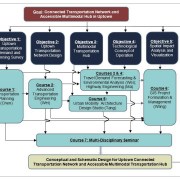
The goal of the proposed project is to adapt and integrate a series of disciplinary courses from the existing CEAS and DAAP curriculums to produce products that proactively enhance the Uptown Innovation corridor from “smart” multimodal choice, transit-bike-pedestrian friendly, residential-business favorably perspectives. These collaborative courses will primarily target undergraduate students. Major activities associated with project design, research and system development will be executed at the 1819 Innovation Hub.

To fulfill the goal, the following objectives will be achieved through designated coursework:

  • Objective 1: To conduct the Uptown Transportation Demand and Planning Survey among community collaborators to inquiry the information about future socioeconomic trends, demographic and employment changes, land use demand, multimodal transportation vision, and transportation infrastructure needs for Uptown development.
  • Objective 2: To develop a conceptual design of the Uptown Transportation Network and Multimodal Transportation Hub to address the documented demand and needs, including access to bike infrastructure and pedestrian routes as an important part of the MLK “Grand Boulevard Plan”. The conceptual design also considers how the network and hub will enhance the visioning service and accessibility across all modes of movement among institutional assets and neighborhood in Uptown, the surrounding areas and the entire Cincinnati region.
  • Objective 3: To develop a conceptual design of the Multimodal Transportation Hub that will support BRT, Bus, Shuttle, Streetcar linkages and is proximate to a proposed LRT alignment. Commuter parking capacity is called for as the hub may have a direct link to SB I-71 off-ramp to MLK.
  • Objective 4: To produce the Concept of Operation in terms of the technological innovation in future with an overview of best practices in “smart mobility” that might be applicable to support the Uptown Transportation Network and Multimodal Transportation Hub.
  • Objective 5: To analyze, visualize, and compare social, economic, physical, and environmental consequences of different scenarios related to the Uptown Transportation Network and Multimodal Transportation Hub.

Collaborative Courses

Six courses from the existing CEAS and DAAP curriculums are selected to formulate the series of the collaborative courses (SCC) for producing the outcomes in alignment with the designated objectives. The SCC courses includes:

  • Course 1: PLAN5158/6058 – Transportation Planning, offered by Dr. Na Chen in Fall Semester 2018. This course provides the foundation for further analyses in other courses.
  • Course 2: CVE5110C/6110C – Advanced Transportation Engineering, offered by Dr. Heng Wei in Fall Semester 2018. This course works along with Course 1 to use the survey results as guides for producing the conceptual design of Uptown Transportation Network, which serves as the starting point for the following courses.
  • Course 3: CVE5112/6012 – Travel Demand Forecasting and Environmental Analysis, offered by Dr. Heng Wei in Spring Semester 2019. This course continues the Uptown Transportation Network design with a focus on the conceptual design of the Multimodal Transportation Hub.
  • Course 4: CVE5124/6024 – Highway Engineering and Safety, offered by Dr. Jiaqi Ma in Spring Semester 2019. This course accompanies Course 3 by providing alignment and geometric design of roadways associated with the Multimodal Transportation Hub.
  • Course 5: ARCH4002 – Urban Mobility Architecture Design Studio, offered by Ming Tang in Spring Semester 2019. This course will include the conceptual designs developed in Courses 2-4 to create a design responding the future urban mobility.
  • Course 6: PLAN5191/6091 – GIS Project Formulation & Management, offered by Dr. Xinhao Wang in Spring Semester 2019. This course takes the survey result (Course 1), Uptown Transportation Network design (Course 2), and Multimodal Transportation Hub design (Courses 3 and 4) and conceptual and schematic design (Course 5) and conducts spatial analysis to provide system-wide consequences of different development scenarios.
  • Course 7: Multi-Disciplinary Seminar.