Posts

Honors Seminar student projects

“Human-Computer Interaction in the Age of Extended Reality & Metaverse” student projects

Spring. 2024.  UC

Under the guidance of Ming Tang, Director of the XR-Lab at Digital Futures and DAAP, UC, this honors seminar course has propelled students through an immersive journey into the realm of XR. The course encompasses Extended Reality, Metaverse, and Digital Twin technologies, providing a comprehensive platform for theoretical exploration and practical application in XR development.

The coursework showcases an array of student-led research projects that investigate the role of XR in various domains, including medical training, flight simulation, entertainment, tourism, cultural awareness, fitness, and music. Through these projects, students have had the opportunity to not only grasp the intricate theories underpinning future HCI developments but also to apply their skills in creating immersive experiences that hint at the future of human-technology interaction.

Read more

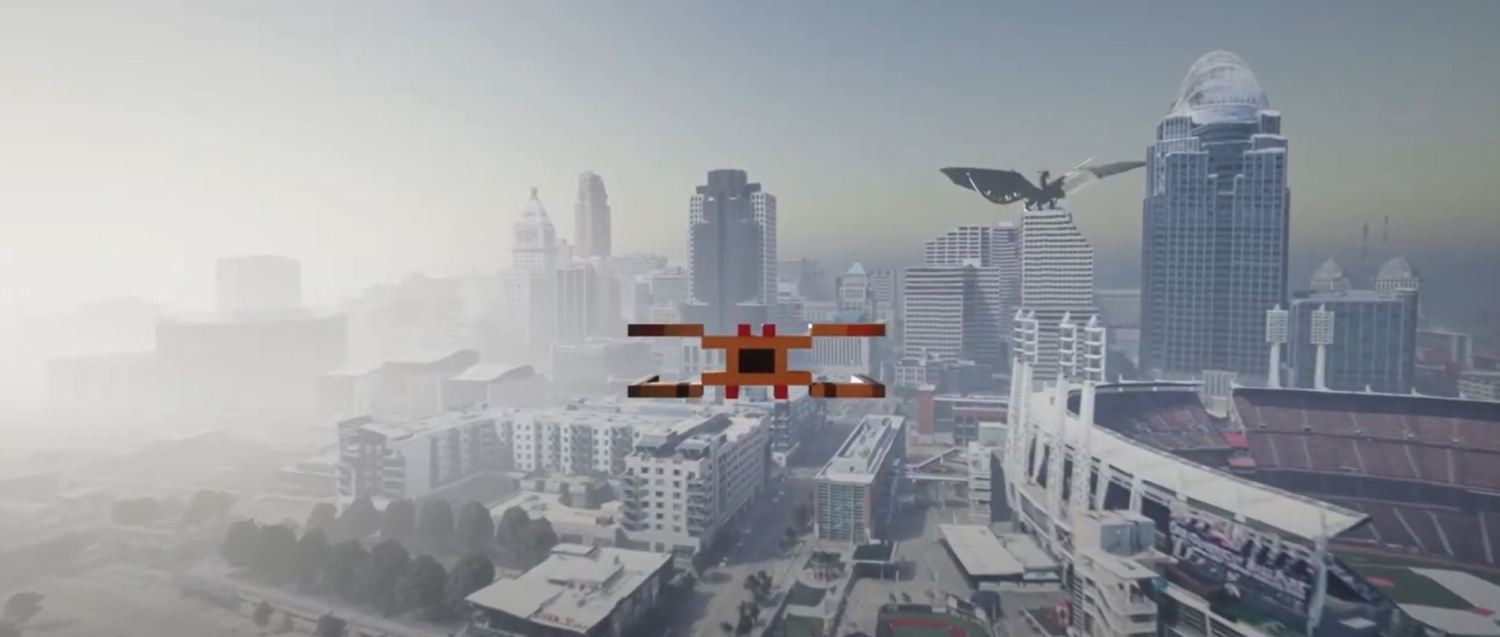
Digital Twin of Cincinnati

A realtime flythrough demo for Digital Twin of City Cincinnati

Digital Futures Building at the University of Cincinnati

Destroy Alien buildings near the UC campus. Project developed by students Cooper Pflaum and Nishanth Chidambaram. 

P&G Metaverse

Title: Leveraging Metaverse Platforms for Enhanced Global Professional Networking – Phase 1

Ming Tang, Principal Investigator

Amount: $32,416

Funding: P&G Digital Accelerator.

Gotal: Metaverse technologies for global engagement. Human-Computer Interaction, Digital Human. Immersive visualization. 

  • P&G Team. : Elsie Urdaneta, Sam Azeba. Paula Saldarriaga, JinnyLe HongOanh
  • UC Team: Ming Tang, Students: Nathaniel Brunner, Ahmad Alrefai, Sid Urankar

In Phase 1 of the “Leveraging Metaverse Platforms for Enhanced Global Professional Networking” project, conducted in partnership with P&G, the XR-Lab proposes a pilot study aimed at identifying and analyzing the top five metaverse platforms best suited for professional networking and conferencing.  The metaverse has opened unprecedented opportunities for communication, collaboration, and social engagement, offering innovative solutions for professional networking and conferencing. In Phase 1, “Surveying the Current Metaverse Landscape,” the UC team examined the top five metaverse platforms to evaluate their potential for replicating global in-person professional networking experiences and supporting multi-user online conferences.

This phase provided a systematic assessment of the leading platforms suitable for professional networking and conferencing. The team analyzed how these platforms leverage emerging technologies to create immersive experiences, such as hosting online conferences and facilitating discussions with global experts. The Phase 1 final report delivered a comprehensive evaluation of the strengths and limitations of each platform, along with recommendations for platform selection based on specific criteria such as audience size, interactivity, and technical requirements.

Additionally, the UC team demonstrated how platforms such as Mesh and Hyperspace can be customized for specific events, including tailored branding and interactive features designed to enhance professional networking and conferencing. These demonstrations provide valuable insights for P&G, highlighting how metaverse technologies can be strategically developed and adopted to expand global engagement and enable innovative event experiences.

Customized Metaverse Demo developed by the UC Team.

Please reach out to the P&G Team for the final report. 


Related Links:

paper SpaceXR in HCI 2024

SpaceXR: Virtual Reality and Data Mining for Astronomical Visualization ” is published at the 26th HCI International Conference. Proceeding Book.  Washington DC, USA. 29 June – 4 July 2024
Authors: Mikhail Nikolaenko, Ming Tang


Abstract

This paper presents a ” SpaceXR ” project that integrates data science, astronomy, and Virtual Reality (VR) technology to deliver an immersive and interactive educational tool. It is designed to cater to a diverse audience, including students, academics, space enthusiasts, and professionals, offering an easily accessible platform through VR headsets. This VR application offers a data-driven representation of celestial bodies, including planets and the sun within our solar system, guided by data from the NASA and Gaia databases. The VR application empowers users with interactive capabilities encompassing scaling, time manipulation, and object highlighting. The potential applications span from elementary educational contexts, such as teaching the star system in astronomy courses, to advanced astronomical research scenarios, like analyzing spectral data of celestial objects identified by Gaia and NASA. By adhering to emerging software development practices and employing a variety of conceptual frameworks, this project yields a fully immersive, precise, and user-friendly 3D VR application that relies on a real, publicly available database to map celestial objects. 

Check more project details on Solar Systems in VR. 


Mikhail Nikolaenko presented the paper at the 26th HCI International Conference. Washington DC, USA. 29 June – 4 July 2024

Digital Human

The digital human project explores (1) high-fidelity digital human modeling and motion capture including Full body + Facial motion capture. (2) Large Language Model integration with digital human, powered by ChatGPT and Open AI. 

Read more