


Metaverse of Simpson’s Victory City Reconstruct & Reimaging of Orville Simpson’s Vision of Urban Futures using AI
Ming Tang. $4500. Supported by SAID Simpson Urban Futures Grant Program. UC. 8. 2026-8. 2027

This project works on the AI-creation of an online Metaverse by reconstructing and reimaging Orville Simpson’s visionary “Victory City.” Using archival materials from the Simpson Collection—including drawings, paintings, and manuscripts—the project will generate digital interpretations of Simpson’s future city through AI-assisted visualization and 3D modeling. The platform will allow users to explore a multiplayer virtual city accessible through web browsers, mobile devices, and VR headsets. In addition to a virtual reconstruction of Victory City, the project will include a digital gallery presenting Simpson’s archival works and a digital installation at the Simpson Center, reintroducing Simpson’s ideas as a contemporary dialogue on sustainable urban futures.
The goal of this project is to translate Simpson’s visionary urban concepts into an interactive 3D digital environment that allows the public to experience and interpret his ideas spatially. Although Simpson’s online archive contains extensive drawings and models, these materials remain largely static. This project transforms them into an immersive platform where users can explore the spatial logic of Victory City. The project emphasis:
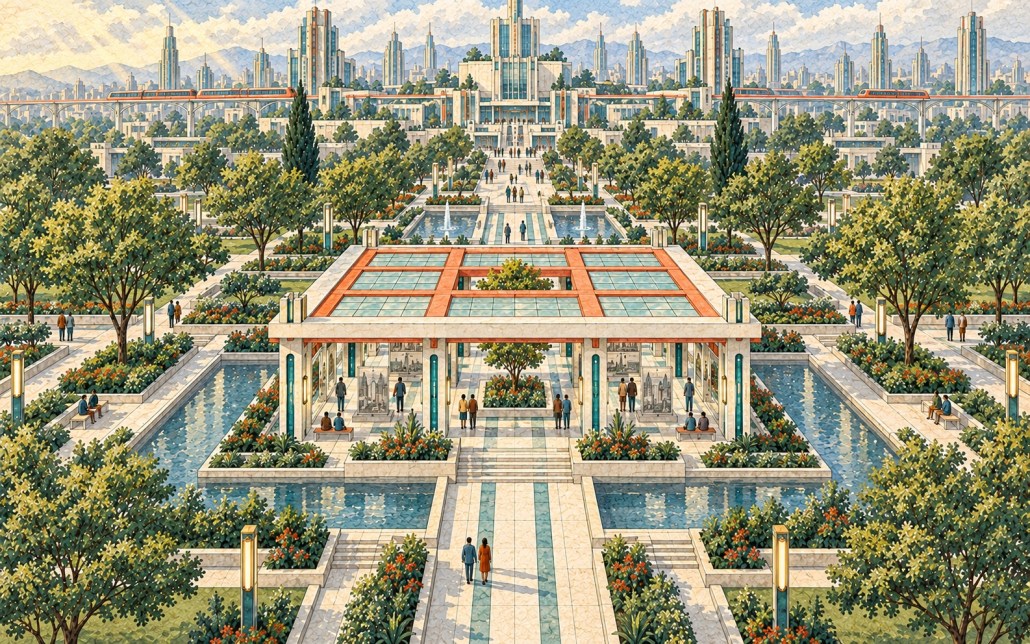
By Stephen Luo + AI. Victory City VIZ.

Re-storying Fort Ancient: An AI-Augmented Digital Twin Installation for Indigenous Earthwork
PI: Ming Tang, Co-Is: John Hancock, Tianyu Jiang, Samira Sarabandikachyani. $5,000. CDRI Grant, DAAP, UC. 5/23/2026- 8/23/2026
Students: Saptarshi Ghosh, Mikhail Nikolaenko, Johnny Bozhi Peng, Ahmad Alrefai
This project proposes the development of an AI-augmented Digital Twin installation for the Fort Ancient Earthworks, a UNESCO World Heritage site in southern Ohio. Using reality capture, spatial computing, and Large Language Models (LLMs), the project will create an interactive web- and mobile-based experience that allows users to explore the site through immersive visualization and natural language conversation.
The project builds upon existing 3D earthwork models previously developed by CERHAS together with earlier XR-Lab spatial computing workflows. This foundation allows the team to focus on AI-driven interaction, interpretation, and public engagement without needing to reconstruct the site from the ground up. The AI system will be developed through a carefully curated Retrieval-Augmented Generation (RAG) workflow using approved scholarly, archival, and Indigenous-informed materials as its knowledge base.


Virtual Reality Development for Historic Avondale and Digital Heritage
Principal Investigator (PI): Anne Delano Steinert, Co-PI: Ming Tang. ($14,000 allocation to DAAP)
Society and Culture Grant, UC Research Office. 2026. University of Cincinnati. Timeline: 1/13/2026-07/01/2026

Project Overview
The Historic Avondale Digital Heritage Project aims to create an immersive Virtual Reality (VR) reconstruction of Cincinnati’s historic Avondale neighborhood, focusing on cultural heritage preservation and community engagement. Through a collaborative effort between A&S and DAAP’s XR-Lab, the project will visualize approximately six urban blocks of Avondale as they appeared in a historically significant period in 1950s, enabling users to explore the environment through VR headsets and interact with its digital elements.
This initiative supports experiential learning, public history dissemination, and digital preservation. The final VR experience will be designed for accessibility on standalone VR headsets (Meta Quest) and optimized for community outreach, classroom education, and museum-style exhibition.


ARCH 7036-04/ARCH5051-04.Elective Theory Seminar, SAID, DAAP, Spring 2025
Faculty: Ming Tang, Professor in Architecture and Interior Design, DAAP. Director of Extended Reality Lab. XR-Lab
Seminar Description
This seminar invites students to explore the intersection of architecture, history, artificial intelligence, and immersive technologies by reimagining the past through digital heritage. Drawing on historic documents and archival materials from Cincinnati, students will work closely with historians to reconstruct a Cincinnati neighborhood as it existed in the 1950s, allowing users to step back in time and experience its spaces and stories through immersive visualization and virtual reality (VR).
Throughout the semester, students will investigate how generative AI, virtual reality (VR), and interactive visualization can preserve and reinterpret cultural memory. Using Unreal Engine as the primary platform, participants will design interactive VR environments for mobile headsets, creating spaces where history, atmosphere, and narrative merge into immersive experiences. The seminar aligns with UNESCO’s Memory of the World initiative, emphasizing the preservation of documentary and architectural heritage for future generations.
In addition to a large collaborative group project, each student will conduct a samll individual research-based design investigation focused on a “lost” historic artifact—such as a forgotten art work or street furniture. Through AI-assisted modeling, reality capture, and digital prototyping, students will gain hands-on experience reconstructing the intangible layers of history while developing advanced technical and conceptual skills in digital heritage creation.

