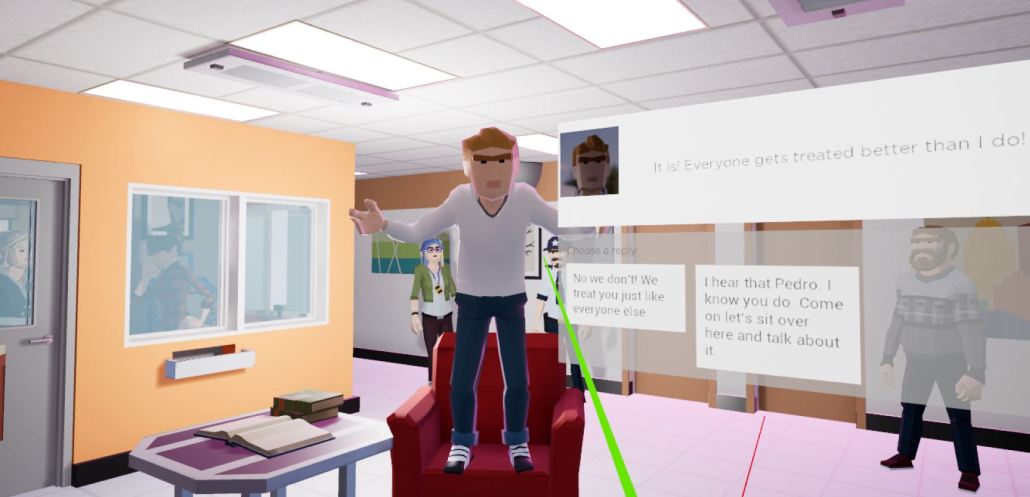
Therapeutic Crisis Intervention Simulation. P1,P2

VR-based Employee Safety Training. Therapeutic Crisis Intervention Simulation 

Grant:

  1. Virtual Reality for Employee Safety Training. Phase I. Sponsored research by the Cincinnati Children’s Hospital Medical Center. PI. Ming Tang. $16,631. Period: 6.2022- 09.2022.
  2. Virtual Reality for Employee Safety Training.Therapeutic Crisis Intervention Simulation-Phase II.  Sponsored research by the Cincinnati Children’s Hospital Medical Center. PI. Tang. $22,365. Period: 2.2023- 12.2023.

Under the leadership of Ming Tang, the XR-Lab is collaborating with the Cincinnati Children’s Hospital Medical Center (CCHMC) to develop a VR-based simulation to enhance employee safety training. This initiative involves creating a virtual hospital environment with interactive characters to facilitate research on diverse scenarios encountered during therapeutic crisis interventions. A vital feature of this simulation is the VR dialogue between a staff member and a teenage patient exhibiting aggressive behavior and mental illness. The primary objective is to equip staff members with the necessary skills to de-escalate tense situations effectively and adhere to appropriate protocols, thereby ensuring a safer and more controlled environment for staff and patients.

Team:

  • Ming Tang, Nancy Daraiseh, Maurizio Macaluso, Krista Keehn, Harley Davis, Aaron Vaughn, Katheryn Haller,  Joseph Staneck, Emily Oehler
  • Employee Safety Learning Lab, CCHMC
  • Extended Reality (XR) Lab, UC

Field of research: Virtual Reality, Safety Training, Therapeutic Crisis Intervention, Mental Health,  Human Behavior Simulation

screenshots from  Mobile VR Quest 2 headset.


Visual Impairment Sim

Our research team at the Live Well Collaborative created a Visual Impairment Simulation VR prototype to simulate glaucoma vision and peripheral vision loss in 2021. Glaucoma comprises a group of glaucomatous optic nerve damage and visual field loss disorders. It is a significant cause of blindness in the United States and is the most common cause of blindness among black Americans. An estimated 1 million Americans over 65 years of age have experienced the loss of vision associated with glaucoma, and approximately 75 percent of persons who are legally blind because of glaucoma are over the age of 65.[1]

A prototype of glaucoma VR simulation was developed by our team in 2021.  A virtual kitchen scenario was created to allow users to experience the challenges of a visual impairment person in an immersive environment. Hand-tracking technology with Oculus Quest 2 was used for creating interactions with virtual objects.

Team: Ming Tang, Ryan Tinney, Alejandro Robledo, Tosha Bapat, Linda Dunseath,  Matt Anthony @ Live Well Collaborative

Screen recording of VR prototype glaucoma scenarios in a virtual kitchen to study cooking activities.


Hand Tracking in VR.

[1] Pizzarello LD. The dimensions of the problem of eye disease among the elderly. Ophthalmology. 1987; 94:1191–5.

XR Lab moved in Digital Futures

As the director of the Extended Reality lab (XR-Lab), I am thrilled to report that our XR-Lab has moved into the new Digital Futures Building at UC.

Our Lab will continue to broaden the scope of collaborations, using our expertise in both academic and professional fields in Virtual Reality, Augmented Reality, and Mixed Reality. We look forward to the long-standing collaborative relationships with faculty at the UC Digital Futures, Criminology and Justice program at CECH, Civil Engineering program, and transportation program at CEAS, Live Well Collaborative, Council on Ageing, Cincinnati Insurance Company, and Cincinnati Children’s Hospital and Medical Center.

Please visit our lab after August 2022 to check out the exciting lab space and facilities at the new UC Digital Future Building.

Location:

Room: 200 at Smart Connected Wing, & 207 VR?AR Center, Digital Future Building

3044 Reading Road, Cincinnati, OH 45206

Request a tour

XR-Lab projects

Contact:

Ming Tang, tangmg@ucmail.uc.edu

Director of Extended Reality Lab, University of Cincinnati.

ASCE presentation

Adebisi, A., Ash, J., Tang, M.  Poster presentation. Evaluating the Performance of Safety Vests for Identifying Road Workers at Work Zones. 2022 ASCE International Conference on Transportation & Development (ICTD 2022)  American Society of Civil Engineers. ASCE. Seattle, WA. 05. 2022

Team: John Ash, Ming Tang, Adekunle Adebisi, Julian Wang, Jiaqi Ma. 

Funded by the Ohio Department of Transportation (ODOT)


More information on this project can be found at IRis Ignite conference,  Access Vest or ODOT research database


IRiS Ignite talk

Ming Tang presented the recent research project at the annual conference hosted by the Institute for Research in Sensing (IRiS), May 25th and 26th, 2022 at UC. This event re-imagines the traditional academic conference to forge novel connections and stimulate new interdisciplinary conversations on the broad topic of sensing, including work on perception, sensor technology development, and ethical innovations in sensing research. 

Project:  Use eye-tracking to measure the effectiveness of safety vests

Team: Ming Tang, John Ash, Adekunle Adebisi, Julian Wang, Jiaqi Ma. 

Funded by the Ohio Department of Transportation (ODOT)

Work zones are an essential component of any state transportation agency’s construction and maintenance operations. As such, agencies apply numerous practices to keep their workers safe during construction operations. The Ohio Department of Transportation (ODOT) recently invested in several more advanced items to improve worker safety (and traveler safety, by hopefully reducing the number of crashes overall). Specifically, ODOT invested in Type 2 and 3 safety vests, halo lights, and reflectors on the back of dump trucks. In 2020, a team of researchers from the University of Cincinnati (UC) worked with the Ohio Department of Transportation to assess the effectiveness of safety vests for day and night use.

The simulation-based evaluation used measurements to create realistic retroreflective vests, lights, and other safety equipment in virtual scenarios. These items were then placed in different virtual work zone environments, each of which had different work zone setup conditions, traffic control, vests worn by workers, time of day/ambient lighting, etc. Through an eye-tracking experiment measuring participants’ gaze on workers in different virtual work zone scenarios and a driving simulator experiment in which participants drove through virtual work zones and were asked follow-up questions on worker conspicuity, subjective and objective measures of worker visibility were obtained.


More information on this project can be found at  Access Vest or ODOT research database